
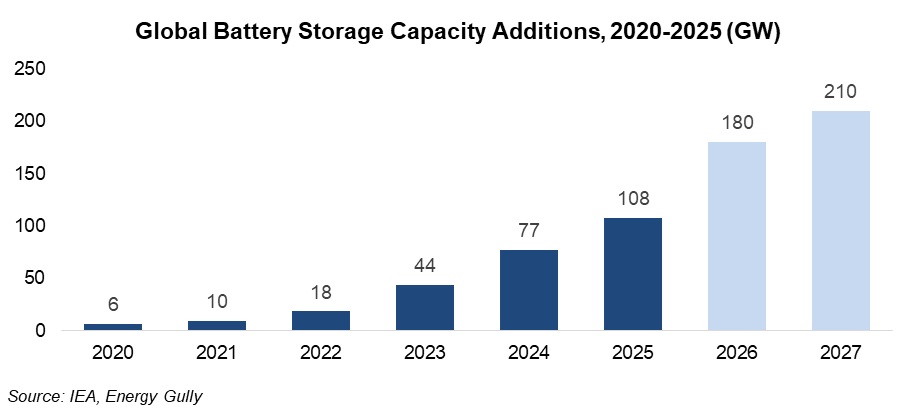
Global battery storage capacity is set to grow strongly over the next two years, with annual additions projected at 180-210 GW. China, the US, India and Australia will drive most of this growth. The long-term outlook is also robust, and growth centres may shift over the next decade as more countries in Europe, Latin America and Sub-Saharan Africa add capacity.
What is driving the battery storage surge?
- Falling battery costs: Lower costs have made battery storage increasingly competitive with conventional options for balancing electricity supply and demand. According to the IEA, battery storage costs fell by more than 90% between 2010 and 2025. Manufacturing scale, improved production processes and the growing use of lower-cost lithium iron phosphate (LFP) batteries have all contributed.
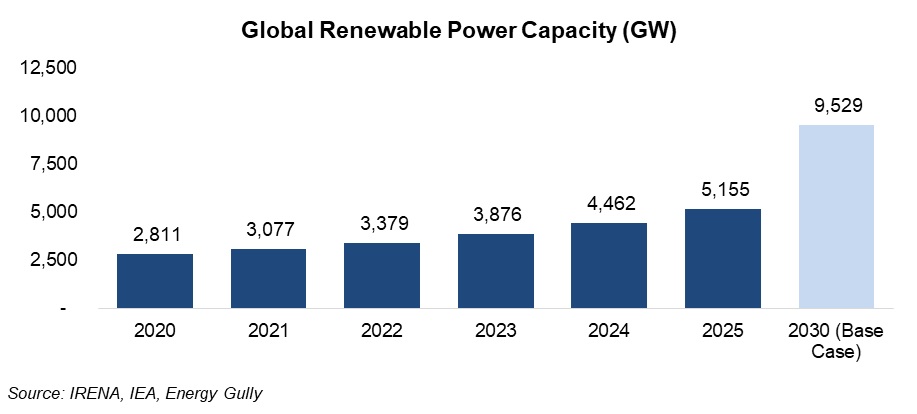
- Growing renewable power capacity: Global renewable capacity continues to grow, but countries are now looking beyond capacity additions. They want to raise the utilisation of these plants to meet their energy transition goals. In India, for instance, renewables (including hydro) account for around 52% of installed capacity but only around 26% of electricity generation. The IEA projects global renewable capacity to reach 9,529 GW by 2030 in its base case, and 10,408 GW in its accelerated energy transition case. As more solar and wind enter the grid, storage is needed to shift power to when it is wanted.
- Policy support: Government policies are helping make battery projects financially viable through investment incentives, storage procurement, renewable integration requirements, and capacity-market mechanisms. In the US, standalone energy storage projects remain eligible for the investment tax credit. India is combining viability gap funding, competitive procurement, transmission-charge waivers and domestic manufacturing incentives to accelerate deployment. In China, policies supporting the pairing of storage with renewable projects have boosted battery deployment.
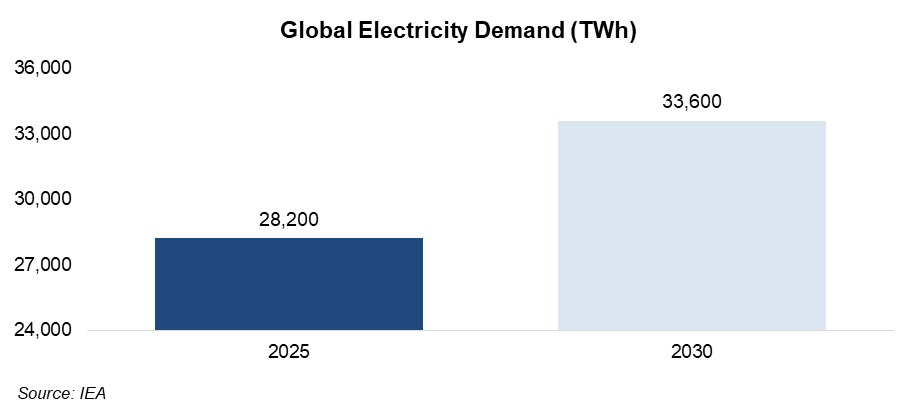
- Rising electricity demand: Electricity demand is rising due to electrification, electric vehicles, industrial expansion, and data centres. As per the IEA, global power demand is set to rise at an average annual rate of 3.6% between 2026 and 2030, adding roughly 1,100 terawatt-hours (TWh) every year. The global electricity consumption is expected to reach 33,600 TWh by 2030, up from 28,200 TWh in 2025. Batteries can provide additional capacity during periods of peak demand without requiring the construction of new conventional power plants.
- Multiple revenue streams: Battery energy storage systems are becoming more attractive investments because developers can increasingly earn revenue from several electricity markets and grid services using the same asset. The central concept is revenue stacking which involves combining income from energy arbitrage, capacity payments, ancillary services and other applications to improve project returns and reduce dependence on any single revenue source. A July 2026 study published in the Journal of Energy Storage found that participation in Great Britain’s wholesale and balancing markets could increase battery profits by up to 250% compared with wholesale arbitrage alone. However, these revenues cannot always be added together without considering operational constraints. A battery committed to providing reserve capacity may not be fully available for energy arbitrage at the same time. Battery degradation, efficiency losses, market access and grid connection limits also affect profitability.
Conclusion
Battery storage has become a highly dynamic market. Capacity is growing, new players are entering the sector, and project owners are stacking revenue streams to improve returns. The markets that recognise these trends earliest, and treat storage as core infrastructure rather than a supporting asset, will be best placed to capture the benefits.
Short on research bandwidth? Our Research-as-a-Service (RaaS) works as an extension of your team, delivering the analysis you need, when you need it. Learn more about our RaaS service at energygully.com or by writing to us at contact@energygully.com.