
LPG consumption in India continues to be constrained by the available supply. As per the latest data released by PPAC, LPG consumption in India was 2.3 million tonnes (MMT) in July, an increase of 7.5% on a monthly basis but 16.4% lower on a yearly basis. Domestic production, meanwhile, is very strong as refiners are maximizing their LPG output yield to meet the domestic demand for this sensitive product. Though PPAC is yet to release its official production figure for July, we expect production totaled 1.4 MMT in July, a strong increase of 24.9% on a yearly basis.
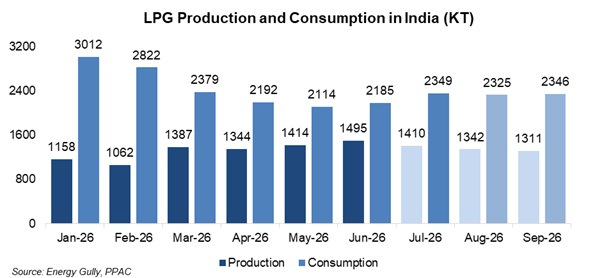
Over the near-term, we believe the ongoing story will continue. Refiners will continue maximizing their LPG output while domestic consumption will remain capped because of the time gap restrictions on cylinder booking. The minimum time gap between two domestic LPG refill bookings is still 25 days in urban areas and 45 days in rural areas.
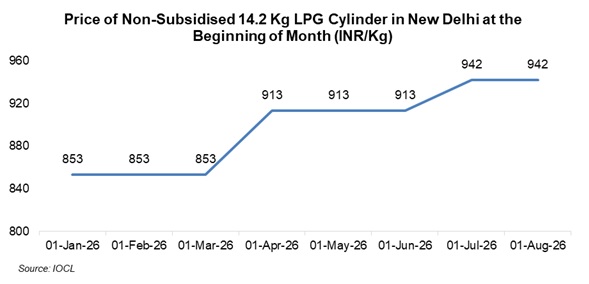
There has been no cut in the price of the domestic LPG cylinder recently despite lower Saudi Aramco Propane and Butane CP for July. However, there have been no further hikes either. The last price hike was on June 7, 2026, when the price of the non-subsidised 14.2 kg LPG cylinder in New Delhi was increased by INR29/cylinder to INR942/cylinder.
The government has restored LPG supplies to industrial customers, including hotels and businesses. The price of the 19 kg commercial LPG cylinder has also been cut twice since July, as its price was raised sharply following the Middle East crisis. Following the latest cut, a 19 kg commercial LPG cylinder in New Delhi cost INR2,738, 12% lower than the price in June 2026 but still 62% higher than the price in January 2026.
Demand from the industrial sector, however, is not going to substantially change the demand story, as the domestic segment continues to account for the bulk of LPG consumption in India. Over April-June 2026, the domestic sector accounted for 90% of LPG consumption, up from 87.6% over the same period last year. The non-domestic/industry/commercial sector accounted for 8.6% of total LPG consumption over April-June 2026, compared to 8.4% in the same period last year. This means that despite the reduced supplies to this consumer base in 2026, its overall share in the consumption basket is still intact. The share of auto LPG in the overall consumption basket, however, has seen de-growth as it is getting displaced by CNG. The overall share of auto LPG in LPG consumption has averaged a mere 0.4% over April-June 2026.
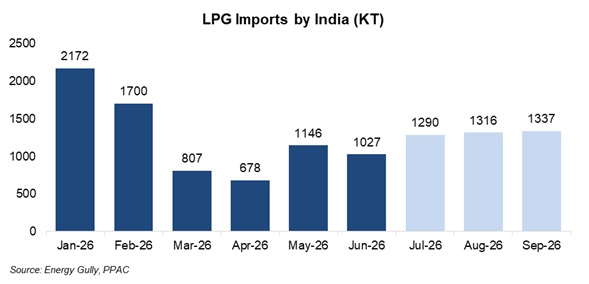
Turning to India’s LPG imports, though the country has swung strongly towards US LPG, the country’s imports are still quite weak compared to the pre-crisis level. As per our estimates, India imported 1.2 MMT of LPG in July 2026, 41% lower than the January 2026 level. As vessel traffic through the Strait of Hormuz is still restricted, we forecast India’s LPG imports to be around 1.3 MMT in each of August and September. This forecasted import figure is still much lower than the average monthly imports of 1.9 MMT over August and September of 2025.
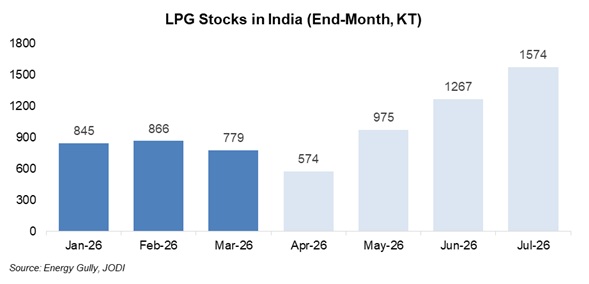
On stocks, JODI has not published India’s LPG stocks data since April 2026. However, our internal calculations show that India’s LPG stocks have increased substantially over the past two months. At the end of July, India’s LPG stocks are expected to be around 1.5 MMT, an increase of 86% compared to the January 2026 level. Nevertheless, these stock levels are still not adequate at a time of crisis like today. For instance, the existing stock level could only meet around 20-22 days of India’s LPG consumption at the current rate. This is the reason the government has still not done away with the minimum time gap restriction on LPG cylinder booking.
Overall, India’s LPG market has shown great resilience in this time of crisis. Government measures, import diversification strategy, and market signals via pricing have helped manage the current crisis effectively.
For deeper analysis and to get regular actionable intelligence on India’s oil market, subscribe to our monthly India Oil Market Report (IOMR). Alongside the analysis, subscribers receive an extensive data file, allowing teams to integrate those insights directly into their internal models, dashboards, and workflows.
Write to us ‘contact@energygully.com‘.