
India has eased the LPG booking rules for rural households. The minimum interval between domestic cylinder bookings for rural consumers has been cut to 25 days from 45 days. With this change, all domestic consumers, rural and urban, must wait at least 25 days between bookings.
It has been more than six months since the Iran-US conflict began. In the initial months, fears of a supply shortage led to panic buying and long queues outside LPG distributors. The government responded with several measures: it lengthened the mandatory gap between bookings, raised LPG imports from the US, temporarily cut supplies to commercial users, and directed refiners to shift their production slate towards LPG. These steps have worked. The domestic supply chain is under control and the queues have disappeared. So the question is: why hasn’t the government restored the pre-crisis waiting period?
Before the crisis began in early 2026, the standard minimum interval between domestic LPG bookings was 21 days nationwide, for urban and rural consumers alike. The rule existed to curb hoarding, prevent diversion of domestic LPG to commercial use, and ensure enough empty cylinders were available for refilling. With conditions looking largely normal to the public, why is the 21-day norm not back? Let’s look at the below points to find out the reason:
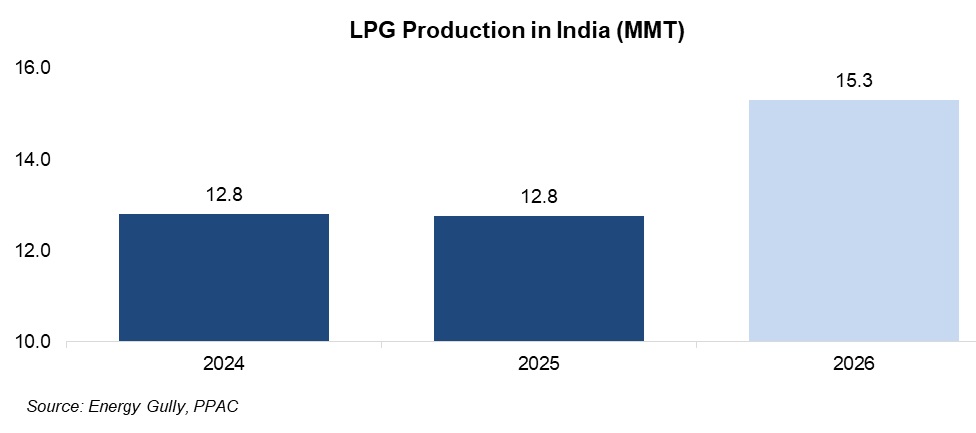
Domestic LPG production is strong: Indian refiners are maximizing LPG output as per government’s directive. We project domestic LPG production at 15.3 MMT (486 MBD), in 2026, up 20% y-o-y.
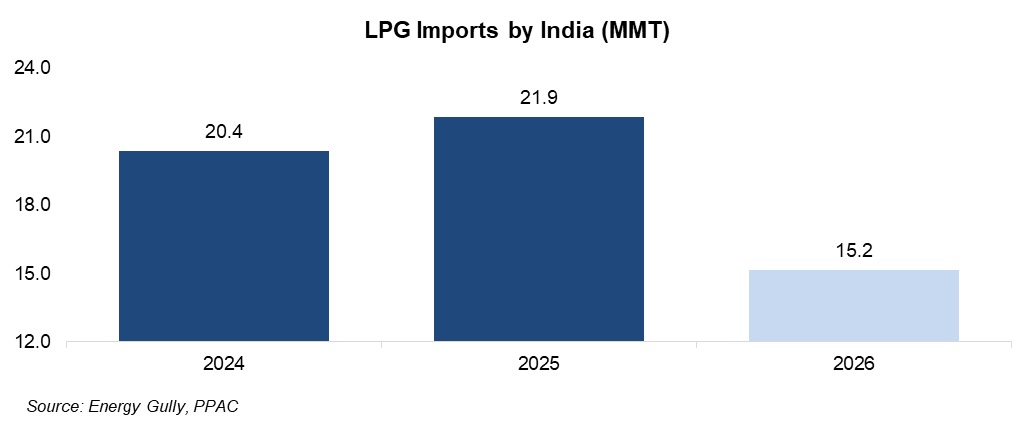
LPG imports are set for a steep fall: Securing LPG in the current international environment is challenging because India must compete with other nations for cargoes. The challenge is greater for India because, before the crisis, it sourced close to 90% of its imports from the Middle East. Replacing a large share of that volume (approximately 19 MMT in 2025) is difficult. India has increased its purchases from the US, but these cannot fully offset the loss of Middle Eastern supply. We project India’s LPG imports at 15.2 MMT (483 MBD) in 2026, a steep 31% fall y-o-y.
 Adding domestic production and imports gives a proxy for total supply, which we project to fall 12% y-o-y year in 2026. This is the key reason the government hasn’t yet returned to the 21-day interval as the supply situation is yet to normalise.
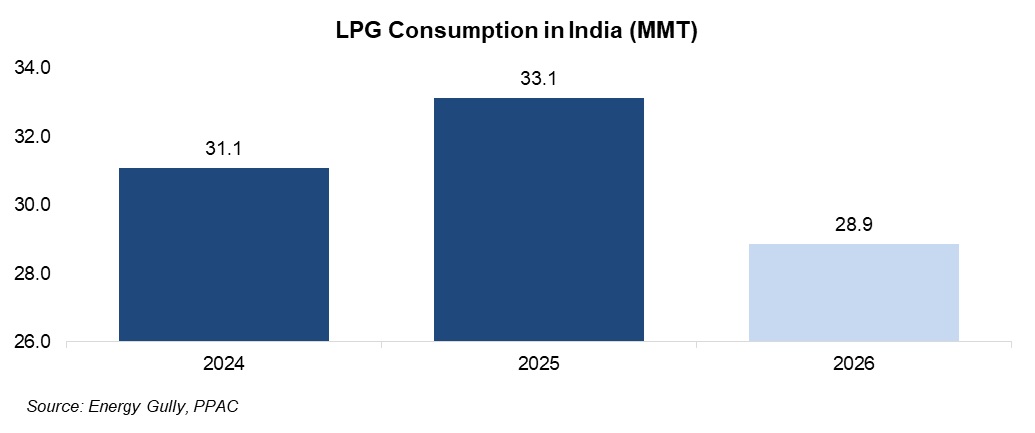
Consumption is constrained by supply: LPG demand in India is currently being determined primarily by availability. Reflecting tight supply, consumption is projected to fall 13% y-o-y to 28.9 MMT (919 MBD) in 2026. Nevertheless, we do acknowledge the focus of Indian government on expanding PNG connections over the recent months. This is also playing its role to substituting LPG however its substantial impact would be visible more on the medium-term story instead of the short-term.
Taken together, the booking gap remains a key supply management tool for the government. Until the conflict eases and the international market becomes more conducive to imports, the interval is likely to stay above the pre-crisis 21 days, even though the queues are now a thing of the past.
For deeper analysis and to get regular actionable intelligence on India’s oil market, subscribe to our monthly India Oil Market Report (IOMR). Alongside the analysis, subscribers receive an extensive data file, allowing teams to integrate those insights directly into their internal models, dashboards, and workflows.
Write to us ‘contact@energygully.com’